Soda Religion (Aris Productions) 2026 Review
If you thought the "Cola Wars" of the 1980s were just a marketing gimmick, director Aris Thorp has a carbonated wake-up call for you. Soda Religion is a fever dream of a film that imagines a post-apocalyptic wasteland where the only thing more precious than water is the syrup that flavors it. The world is divided into two warring theological factions: the "Keepers of the Crimson Ribbon" (Coke) and the "Disciples of the Blue Sphere" (Pepsi). It’s a high-concept satire that manages to be both absurdly bubbly and shockingly dark.
The film follows Brother Julian (Timothée Chalamet), a young acolyte in the Coca-Cola cathedral who begins to doubt the divine right of High Fructose Corn Syrup. Chalamet plays the role with a frantic, caffeinated energy, capturing the desperation of a man who has spent his entire life believing that "The Real Thing" is the only path to salvation. His performance is mirrored by the antagonist, High Priestess Effie (Florence Pugh), who leads the Pepsi legions with a chilling, citrus-infused charisma, claiming that her people are the "Choice of a New Generation" of gods.
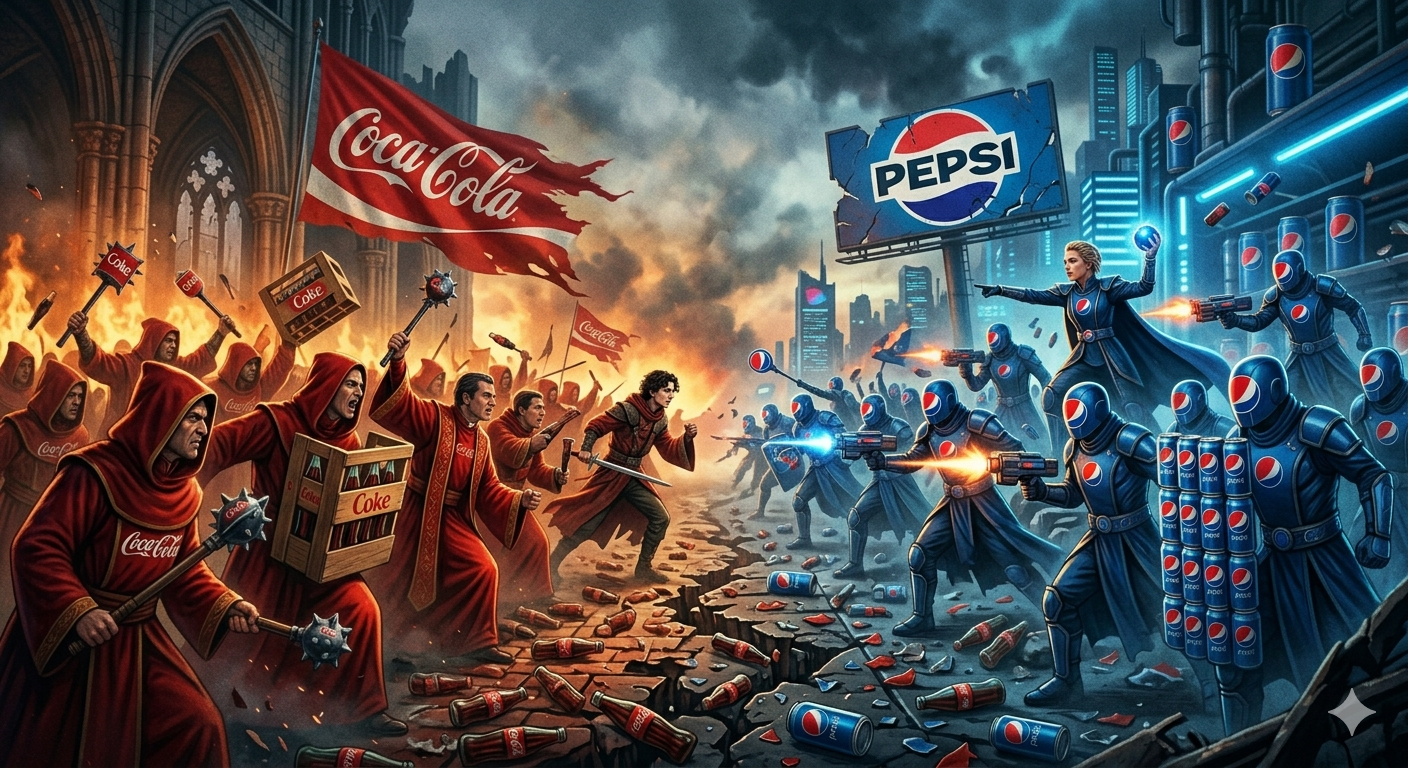
The battle sequence in the film really goes all out! I don’t know which side I would pick.
Visually, Soda Religion is a feast for the eyes, utilizing a saturated color palette that makes every frame look like a vintage billboard. The "Red Territory" is draped in Victorian Americana, all wood-grain bars and glass bottles, while the "Blue Bastion" is a neon-soaked, futuristic fortress built from aluminum cans. The production design is meticulous, turning every piece of soda memorabilia into a sacred relic. Seeing a rusted vending machine treated with the same reverence as the Ark of the Covenant is a stroke of comedic and visual genius.
The central conflict comes to a head during the "Great Fizzing," a massive battle sequence set in the ruins of an old bottling plant. The choreography is inventive, featuring weapons powered by CO2 cartridges and grenades filled with Mentos. However, the film doesn't just rely on spectacle; it uses the absurdity to poke fun at the tribalism of modern consumerism and the arbitrary lines people draw in the sand. When a third, nomadic tribe of "Dr. Pepper Outcasts" appears—claiming to worship 23 secret deities—the film hits its satirical peak.
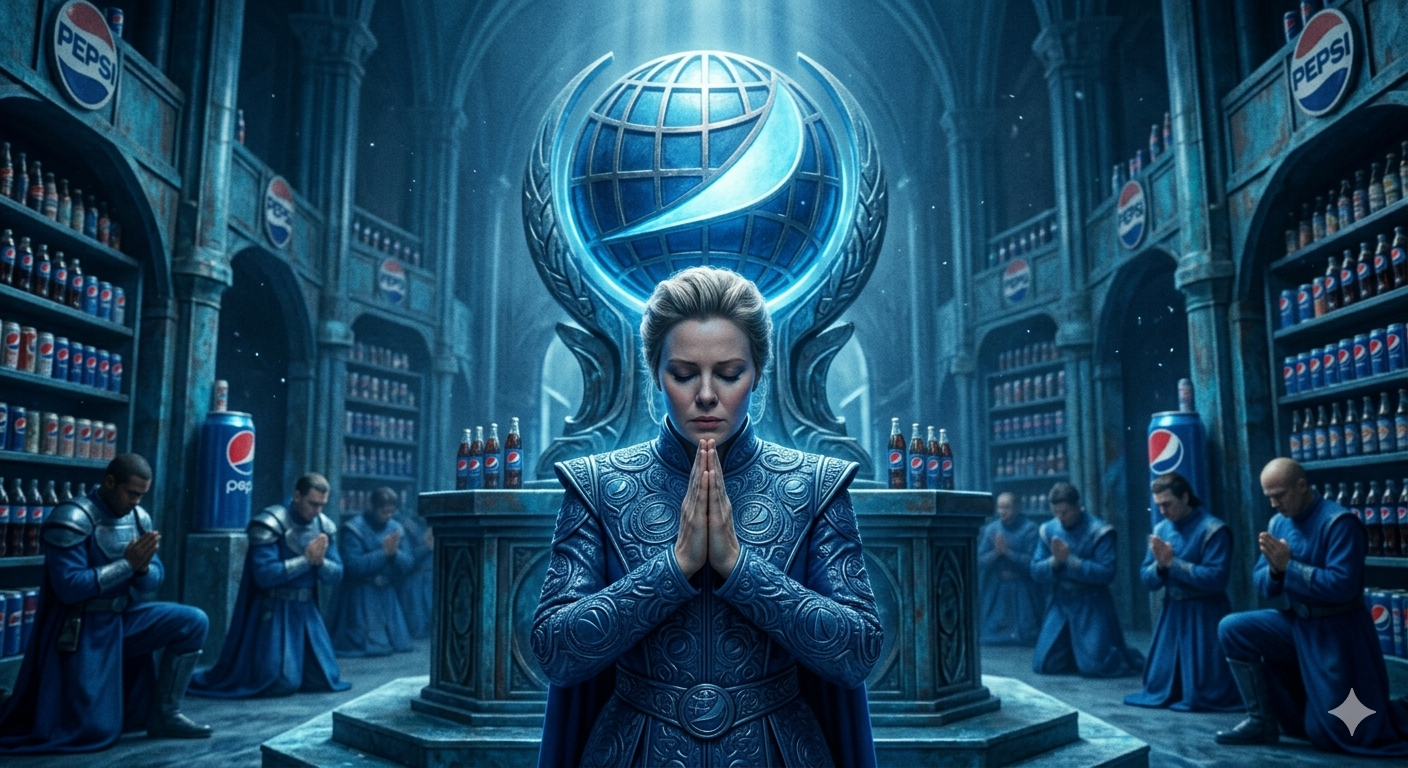
High Priestess Effie praying to the Pepsi Gods. The chanting epic choral music really makes this scene wicked cool.
Despite its brilliance, the movie occasionally loses its carbonation in the second act. The pacing slows down as it gets bogged down in the complex "theology" of flavor profiles and carbonation levels, which can feel a bit like a marketing seminar gone wrong. At nearly 169 minutes, the joke threatens to run flat. Yet, every time the energy dips, a sharp bit of wit or a bizarre ritual involving a "sacred ice cube" pulls the audience back into the madness.
Soda Religion is ultimately a refreshing, if slightly chaotic, cinematic experience. It forces us to look at our brand loyalties through a distorted, sugary lens, proving that whether you prefer red or blue, the outcome is usually just a toothache. It’s a bold, sticky masterpiece that isn't afraid to ask the big question: Is life better with "The Joy of Cola," or is it "Always Coca-Cola"? By the time the credits roll, you’ll be parched for more—and maybe a glass of water.